Search This Blog

Saturday, July 20, 2013

New Poem

     I don't usually post my work online. My son cautions me against the practice, and his counsel on this particular subject, seems wise. But today I am choosing to post my most recent poem. I just wrote it a few days ago, after the Zimmerman verdict, so it will probably be revised a few times yet. Still I share it now in support of the president's statement yesterday. I do welcome feedback.


For the Other Parents

Since the year 1863
there has been a talk many American parents
have to have with their American sons
at just about the time that their son’s
voices begin to change, and their muscles
begin to harden into impending manhood,
at just about the time that referring
to the boy as boy changes too.
They say things like these,
things I have never had to say to my son,
nor have any of my ancestors
since the year 1863.

***

There will be times, from now on
when people will be afraid of you.
You have to be aware of this at all times,
to develop a sense for it,...  to feel it
before it turns bad, because
very bad things can happen to you
when people are afraid of you.
You can’t play with toy guns anymore,
or swords, or pick up pipes, or even sticks.
Always be aware of your surroundings.
Try not to go anywhere alone,
especially at night.
If you’re being followed try to find someone
so you’re not alone.
Cooperate with authorities even when
your dignity makes that hard.
Don’t do anything with your hands but put them up.
Don’t worry about winning or losing.
Your goal is to survive.
Let them stand their hallowed ground
that they’re afraid of you taking.
You just stay alive.
And always - remember
there is nothing wrong with you,
nothing wrong with the way you look.
You are who you have always been
and that is the ground that
you have to stand.

All rights reserved. (C) Tammi J Truax. 2013.


Tuesday, July 16, 2013


Wedding Vows


    In the eighties I was a struggling college student attending UNH. The first in my family line known to have gone off to college. Since my family goes back to the founding of America, that was a pretty long line. The reason the rest of us hadn't became quite clear. My people have never had much dough, and college, even back then, took a lot of dough. My parents did help me as best they could, and I borrowed money as best I could, at usurious Reagan era rates. But to make ends meet, I worked part time at any kind of work I could get that would allow me to put classes first.
     One of those jobs was for a caterer. A rather unscrupulous man, one might call a horse of a different color, who managed to bounce pay checks for thirteen dollars. But I stuck it out for a while. Commuting from my crowded apartment in Dover where passing trains caused my bed to do an Exorcist type of ritual a couple of times a day, I would drive in my shiny green 1978 Plymouth Duster to some breath taking estate on the seacoast of New Hampshire and wearing some God-awful-ugly black and white outfit in the heat of a summer afternoon I would wait on beautiful people who had come to watch a happy young couple celebrate their lavish wedding. Usually under big white tents, candle lit, on expansive rock walled lawns that were never easy to navigate with trays of china and crystal. In my own little invisible way I did what I could to make their day the special treasured memory I knew they wanted. And I used to think, yes like a pathetic little Cinderella, that if I worked hard in school, there would come a day when I wouldn't be the servant anymore. That someday I would be sitting on that side of the table. Smiling, toasting, and not worrying about having enough gas money to make it home. At some low point at one of those summer assignments I vowed to myself that it would be so.
     I did have my own special wedding day on the seacoast a few years later. But almost certainly like many of the pretty people whose weddings I had witnessed, things didn't turn out pretty. My husband got sick and died, leaving me with two small children to raise, which I've been busy doing for the last twelve years. That is what wedding vows are all about; to have and to hold, to love and to cherish, from this day forward, til death do us part…
     As life would have it I recently found myself atop a stunning New Hampshire mountain, wearing a God-awful-ugly black and white outfit and serving beautiful people at someone else’s wedding celebration. It was infinitely harder than I imagined it was going to be when I agreed to the gig. Physically harder, sure, I am fifty now, and carrying heavy trays for hours is not as easy as it looks. But it was also hard on me emotionally.
      I kept going back to my twenty year old self, … so much more hopeful about the beautiful life that she would be rewarded with. So sure that sometime, somewhere, in the future of her blossoming life, it would get soft and easy. Not remotely worried about things actually turning out worse. Never considering radical cell growth or rare tumors or physical agony. Not even able to imagine going to a blacker place where that kind of hope is carefully wrapped up and put away like a bridal veil, too white and virginal for the reality of the day. I was pretty then and think I must have smiled a lot. Probably even giggled. I remember me as sweet and slim and sassy, secure in a world where all the people looking out for me were still alive. I hadn’t thought of those days, or that girl, in a long time. But she has been bugging me a lot lately since I worked the last wedding under another candle lit tent on another beautiful estate.
      The truth is, it was terribly hard for me to be in that position again. To be invisible, with men only speaking to me to say things like, “Come on girlfriend, give me a full scoop of salad.” To be in the back, getting dirty, and listening to the fun. Just like when I was young I was most jealous of the dancing, my favorite part of any celebration. This time though, the mature me was less covetous of the idea of an adoring prince charming and a big shiny ring and a happily ever after, and far more envious of the bride’s pre-wedding accomplishments; namely being a successful writer and having launched her children into happy adulthood. These are my own grown woman aspirations, more important to me than just about anything else is anymore, but which I still have not achieved.
     There is still in me though, some hope left, that I will. Not the little girl have faith in the universe and wait for it to happen kind of hope I had at twenty, but the big girl have faith in myself and make it happen kind of hope I didn't have. Until now.

     I vow. It will.


Saturday, July 13, 2013

Looking forward to this gig


BEAT NIGHT AT THE PRESS ROOM
Thursday July 18 – 7:00 pm
Spoken Word Improvised Music

We have amazing lineup this month, a one-time reunion of poetry royalty! 

Young Dawkins (former Emperor of Scotland)
Larry Simon (former Emperor of Portsmouth)
Tammi Truax (Fair Queen of Beat Night)
Ryan McLellan (The Dark Lord of Exeter)

plus the Beat Night Band
Scip Gallant | keyboards
Scott Solsky | guitar
Chris Stambaugh | bass
Mike Barron | drums
Frank Laurino | percussion
Cynthia Chatis | flutes

followed by The Open Mic – 8:00 pm
with your host Heather Elisabeth

The Press Room 
77 Daniel Street, Portsmouth, NH – 603.431.5186 – pressroomnh.com
(no cover)

Tuesday, July 2, 2013

Martha's lace

Today's most interesting research find; (Well so far that is...)
http://www.universityarchives.com/Find-an-Item/Results-List/Item-Detail.aspx?ItemID=52310

Sunday, June 30, 2013

Vive la révolution! | SeacoastOnline.com

Something I wrote about celebrating Bastille Day.
Vive la révolution! | SeacoastOnline.com

Sunday, June 23, 2013

Getting there...

     I have been working so hard lately, and want to say that seven day work weeks are exhausting. But, this streak of productivity is too good to bring to a halt, so I'm just going along with it like a happy little hitchhiking hippie.
      And I am happy to say that this week a lot of forward momentum was gained. It now looks like both of the books that I am putting out electronically will be ready to go public at just about the same time. Not necessarily the way I wanted to do it, but that is the way it turned out. One is my first novel, (the title was changed to Broken Buckets from Holy Buckets in the end) and will only be offered as an eBook and should be ready any day now. Just a few last minute tweaks to formatting are being worked out.
    The other is a project I have been working on for years. At least five years, maybe longer. Considering it contains so little writing it is surprising how very long it took, and how much effort had to go into it. It will be the reproduction of an old poem (not mine) with brand new illustrations. It is meant to appeal to all ages and I think it will. It will have the most appeal to people with a fondness for the Portsmouth, New Hampshire area, but is not at all limited to the region. For that reason though I am publishing it in print as well as electronically.
     Both books will be ready very soon, and I will be marketing both as I continue plugging away at my historical novel. It is an exciting time for a writer when anything you've been working on comes to some kind of fruition. Fruits are just about ready for picking! I will keep you posted.

Tuesday, June 11, 2013

Blame it on the muse

     Please forgive the lack of blogginess of late. My excuse is a fairly decent one; I've been much too busy working! The historical novel I am working on is coming fast and furious, and I am striving to honor the muse whenever she asks it of me. She's been asking a lot. Believe me, the blog is not the only thing in my life being neglected.
      I did though, take some time a few days ago to hear Nathaniel Philbrick speak to an overcrowded group at my local Barnes and Noble. He is hawking his current book about the siege of Bunker Hill. (Can you believe the price?!) It was really interesting to hear a nonfiction history writer talk about his process which is very much like my own, save the final step of creative interpretation. I bought his book as a Father's Day gift, but want to read it too.
     Also am now very close to the final steps of launching my first novel as an eBook. It has been a lot of work, and I am anxious to get it done. Please stay tuned...

Tuesday, May 14, 2013


Monday, May 13, 2013


Pretty little things...

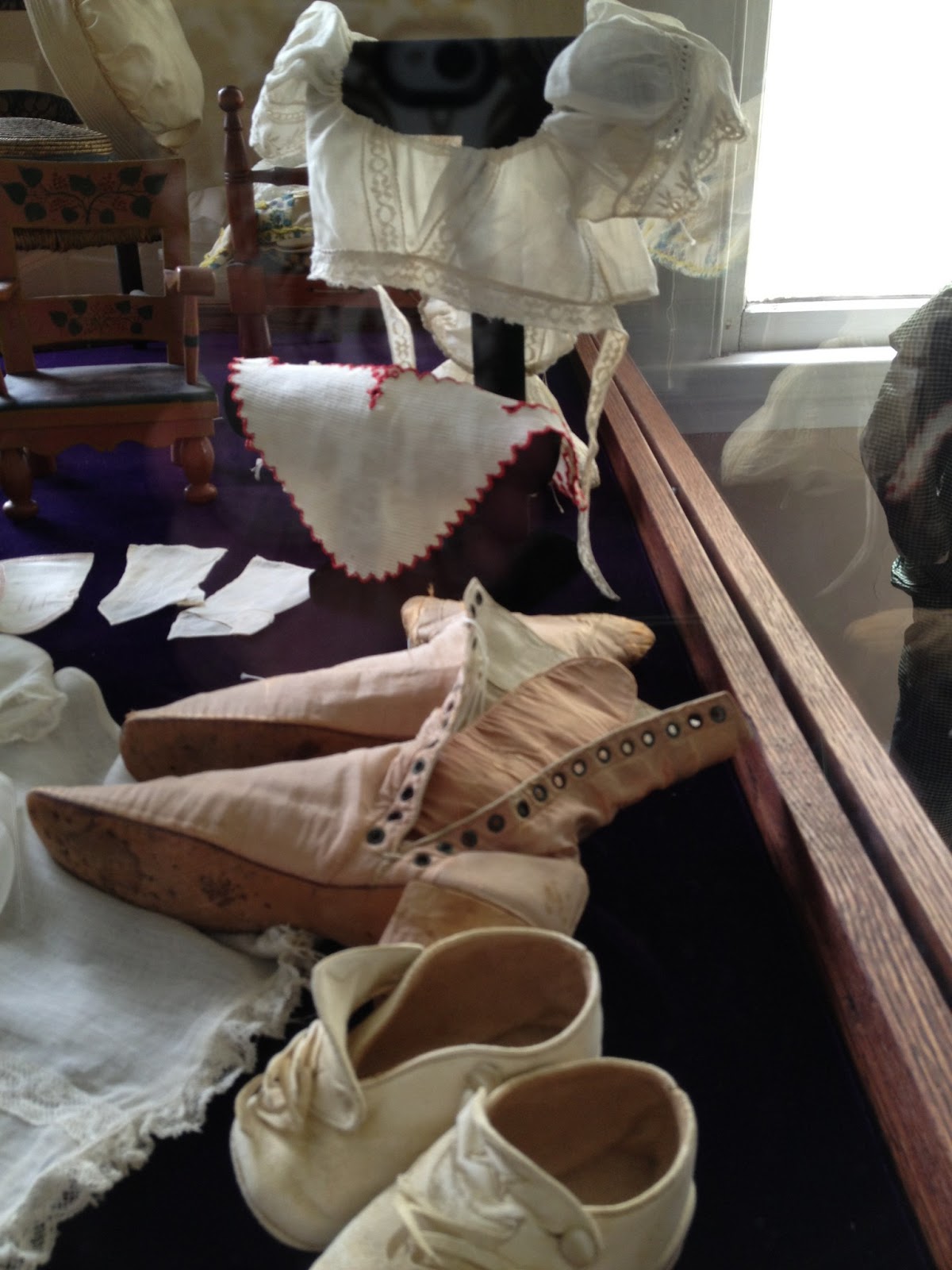
     I visited The John Paul Jones house in Portsmouth, New Hampshire a few days ago.


     They were having a special Mother's Day lecture and exhibit and since I was the only one to show up I scored a private session with head curator and house manager Sandra Rux. 

      While I have always found antique clothing made especially for children to be irresistible,  I attended this talk as part of my research for the novel I am currently working on. I need to be able to write intelligently about American clothing in the late eighteenth century. Not just what people wore, but how they made their garments, and I am starting from scratch as I have almost no skill at all as a seamstress. Here are a few pics of the gorgeous little garments I learned about, though the pics do not do them justice;
Both of these were little boy outfits.


The girl who had the pink boots had an entire pink outfit all made to match.

A little Portsmouth girl, probably age four, wore this silk dress, which is darned all the way around the waist.

      I'm having so much fun writing this book!
   

Sunday, May 12, 2013


Mother's Day Post


     "My mother was the most beautiful woman I ever saw. All I am I owe to my mother. I attribute all my success in life to the moral, intellectual and physical education I received from her." ~ George Washington
     Seems like a good time to announce that the novel I am elbow deep in is about George Washington. He is not the protagonist, or I didn't intend for him to be when I started. So far this book has been quite unpredictable in where it is going even though I know how it ends. It has been such a pleasure to write it  and my only frustration is that I don't have more time to devote to the extensive research that is necessary, and more hours to write.
     Toward that end I have decided that I will begin blogging about interesting things I learn in my research that look like they will become part of the story in one way or another. The introductory quote above is the beginning. I found this quote interesting, because most biographies claim GW's mom was cold, critical and demanding. And I thought that this painting (artist unknown) gives a fairly accurate presentation of the relationship as it sounds like it was.
     Funny thing about history ... we can never really know someone else's truth.


Wednesday, May 8, 2013

Thursday, April 25, 2013

Thinking About Augusten

     Though I have been completely submerged in historical fiction and nonfiction for at least the last year, last night I went to hear Augusten Burroughs speak, and I have been reading his "A Wolf at the Table" ever since I got home. So far I am finding it a very compelling read, as I found him in person. Quirky and humorous and interesting and all-over-the-place. I loved that he mentioned that labels have been bandied about for him on the now very well populated Autistic spectrum. Being as high functioning as he is the labels are rather irrelevant but are immensely interesting when applied to his childhood. I think they perfectly explain both his recall for early childhood memories, and the kind of memories that he has - his way of processing the sensory experiences of childhood were in fact, not average, and I find reading it from that perspective well worth my time. I was surprised to read the very different take on the book in the NYT, linked to below. I like the book and I like Burroughs. He deserves all of his successes!

      http://www.nytimes.com/2008/05/01/books/01maslin.html?_r=0

Tuesday, April 9, 2013

Guys, and guns, and stuff we don't like to talk about...

     After I read this piece (see below) by another writer, it really struck me how strange it is that we seem so unwilling to talk about this big giant well armed elephant in the room. It's downright weird.
     I have a completed novella that I will soon be publishing as an e-book. An agent just told me a few days ago that no publisher will touch a book about dead children and that no one wants to read anymore about Iraq or Afghanistan. My story about men, and guns, and a school in America may be America's dirty little secret. But it's not a very well kept secret. Everybody knows it. And it is kind of 1950's martini-induced repression to so very actively not talk about it. I'm talking. My story is, I hope, just part of what will become a conversation.
    And I hope the writer of this piece gets to have a conversation too. One without censorship. I'd like to respond now, and tell him that I agree with him on all points except the strong role that video games play. I'm sure that they exacerbate the situation, especially when played excessively. Nothing done excessively is good for you. I'll admit my bias, as I am the mother of a young man who has been a gamer most of the years he's been alive. He lost his Dad at 9, had many troubled years as a teenager, but the games didn't make him violent, and he was never obsessed with weapons. He is also a pacifist. Personally I think the big difference for the writer was nature as he noted, but most of all the support system of involved adults. That I think is the essential difference between tragedy and salvation when the mental health of the individual is tanking. The Lakota call it tiospaye, being part of a strong circle of support that prevents failure. It's absence, and what can happen thereafter, is what I have written about, and frankly, what we have all read about already.
     Here is a link to the other writer's blog post, he says was censored by the Huffington Post.
http://peterbrownhoffmeister.wordpress.com/2013/03/04/on-school-shooters-the-huffington-post-doesnt-want-you-to-read-this/

Sunday, April 7, 2013


Bookish Ends

      Yesterday I attended the annual NH Writer's Project conference which is always an interesting mix of meeting new people and seeing people I rarely run into. Of everything I did over the course of the day I was most struck by the odd difference between the first speaker of the day, key note author Andre Dubus, and the last speaker I heard, Pulitzer prize winner Paul Harding.
      I have heard Dubus speak before and always find him crush worthy. Not a lot of guys can get away with audience scolding (regarding our crack pipes), swear lobbing, and talking about Faulkner and skid marked underwear. He does. I have some attention deficit issues and staying focused in lectures can be a serious challenge for me. I have no real coping mechanism for this deficit of mine, and simply move on to a variety of other more compelling activities like making a grocery list, if a speaker can't keep my attention. Mr. Dubus nailed the hat trick of taming my lame brain; making me think, laugh, and jot down something I wanted to carry away with me forever. As with most crushes, much of it is born of similarity. Like me, Dubus was strongly influenced by the time and place of an edgy middle class New England mill town upbringing, and I get him.
     Please don't think I'm dissing Mr. Harding now in comparison. I'm not. I think he's great, but I couldn't have a crush on him. I would be too tired. From trying to keep up with his brain. Which in stark contrast to having attention deficits, seems to be on hyper-drive at every minute and can go in many directions at one time. Listening to him reminds me of a time in the late seventies when I may (or may not) have ingested something hallucinogenic, which may (or may not) have resulted in the world becoming a metaphysical magic kingdom. The whole world. Even tree bark. He can equate plot with Newtonian physics and mechanical drawing. Harding was strongly influenced by the lofty New England transcendentalists, who, truth be told, I don't always get. But he scored a hat trick with me too. We agree on his basic philosophy, "I have faith in art," and apparently, we are both attracted to tree bark.
     I'll leave you with the Yeats poem Harding based his talk on, as it is one of my favorites, and it certainly is a lovelier image to leave you with than soiled underwear hanging in a tree.

     From Ode on a Grecian Urn 1819

"Beauty is truth, truth beauty," - that is all 
        Ye know on earth, and all ye need to know.

Tuesday, April 2, 2013

Mary Oliver!

      I just found out today that a few of my poems will be published in an anthology next year along side the work of Mary Oliver! A poet whose work I so admire. Her poetry is so prayer-like to me. I am so thrilled with this news. So I will share  one of my favorite Oliver poems with you. I love to share this poem with others, especially at graduation time.


The Summer Day

Who made the world?
Who made the swan, and the black bear?
Who made the grasshopper?
This grasshopper, I mean-
the one who has flung herself out of the grass,
the one who is eating sugar out of my hand,
who is moving her jaws back and forth instead of up and down-
who is gazing around with her enormous and complicated eyes.
Now she lifts her pale forearms and thoroughly washes her face.
Now she snaps her wings open, and floats away.
I don’t know exactly what a prayer is.
I do know how to pay attention, how to fall down
into the grass, how to kneel down in the grass,
how to be idle and blessed, how to stroll through the fields,
which is what I have been doing all day.
Tell me, what else should I have done?
Doesn’t everything die at last, and too soon?
Tell me, what is it you plan to do
with your one wild and precious life?

Sunday, March 17, 2013

The story of my Irish ancestors...


     In honor of Saint Patrick's Day
     Excerpt from a novel in progress tentatively titled A Better Life,
      by Tammi J Truax, all rights reserved.

      Maggie hadn’t really wanted to leave her home in County Cork, but her family had needed to send her to America where a better life was assured, and she would be able to send money home to help her large troubled family. It was 1898 and she had only recently turned twenty years of age. Her parents thought she was old enough and sharp enough to venture out on her own and they had worked hard to save the steerage fee and send her off with a carpet bag containing a blanket, two dresses, a few invaluable odds and ends, a cake, and a handful of coin.  Truth was she hadn’t fought the idea of coming with the ferocity she might have if she hadn’t known that if she stayed in County Cork she would have to relent and marry Frankie Sullivan, a boy she’d known all her life and who made her sick. Her older sister had already married a Sullivan, had four Sullivan babies so far, and they were all miserable. Seemed to Maggie you couldn’t be a Sullivan and be happy. Frankie was  drinking and carousing at this very moment she was sure, and if not, was asleep in a stinking heap somewhere.
     Though she hadn’t truly wanted to come to America, she now couldn’t wait to set her feet upon solid ground again. The journey across the sea on this lurching steam ship was the most unpleasant experience of her life which had never been soft and easy. She couldn’t wait to wash the stench of the ship off of her with a hot bath. And while she knew she wouldn’t find her Mum’s cooking in America she was so hungry she felt hollow and was certain her belly would be filled when she made her way ashore. The boat was making an agonizingly slow entrance into the harbor and the wind whipped Maggie’s curls about her head so that her hair pins were rendered useless and she clasped her shawl at her throat while the wind tried to take it back to Ireland. Then she saw it. A huge stone woman reaching up into the sky with a blazing torch and holding fast to the holy book. It was indeed a welcome sight, and Maggie had no doubts that she was welcome and she would find a better life. She could also see the tall buildings of America in the distance and a big long bridge that seemed to be hanging in the sky. The children were jumping up and down, and some of the women cried. More amazing then the Lady of Liberty to Maggie, was the palace. She saw an enormous and beautiful castle on an island and everyone said that was where they were going. That was Ellis Island. It did indeed look like a paradise.

     After dropping off the upper class passengers in one place the captain motored the ship to another port where the steerage passengers were finally allowed to board a barge that took them all to the front entrance of the big brick building. At last they could disembark and climb on American soil. It was time to get in line, first just to get up the main stone stairway where hundreds and hundreds of other people also fell in. It was noisy and exciting and quite frightening. Maggie saw people wearing the strangest clothes, hats and hairstyles. She saw women carrying parcels on their heads and some with baskets on their backs. She saw people trying to walk who were too weak and sick to make it to the end of their journey. She saw family members being separated from each other and terrified children clinging to their loved ones. The uniforms worn by the inspectors were especially intimidating to many of the foreigners. It was clear in short time that not everyone was being welcomed and there were so many people; men, women, and children from all over the world, trying to get through. First, Maggie had to answer 29 questions. That task was easy for her, she always had an answer and didn’t mind telling it. She didn’t even mind when she was asked a trick question like “How would you wash a staircase?“ That one made her smile.
     Next came a medical examination, and she could see quite a few people were failing this inspection as they were whisked off in other directions after a chalk X was drawn on their backs. There was much illness on the ship, but Maggie was strong and healthy. She hadn’t seen many doctors in her life, but this inspection reminded her of how her father had examined a horse he was considering purchasing. When it was her turn a doctor looked her in the eyes, nose and mouth, turned her around, told her to cough, and slammed a stamp across her documents with a yell to move on.   
     The next line was the slowest one and Maggie didn’t understand what it was about. When it was her turn she was given a chair to sit down in while an official examined her documents. “You are unmarried?” “Yes,” Maggie replied. “Who will support you here?” he asked. “I will support myself,” Maggie answered nervously. “You have no male relatives here? No one is here to receive you?” he quizzed. “I have friends on the boat, and there are many other people from my village living in America,’ she offered. “I am a very hard worker, and have a letter of introduction from my church,” she added. He shut her passport book and slid it back at her across the little table. “Without a means of support you cannot stay, and will have to return with the ship. Entry denied. Next!”
     A guard drew an X on Maggie’s back and pointed her in a direction different from her fellow passengers who looked at her with sad and serious silence. She was led by a matron with several very sick and forlorn people to an area of the great hall designated for those denied entry. She sat on a hard wooden bench and listened to languages being spoken that were the strangest sounds she had ever heard. Someone might have noticed her fatigue for eventually she was given fresh water and soda crackers. This first act of kindness made her cry a little. As the day wore on she was asked to tell her story a few times to guards and officials, and she always hoped for a reprieve. Each time she was told she would be put back on a ship bound for Europe in the morning because she could not become a public charge.
     At supper time one of the guards took them to a cafeteria where they were served a soothing and delicious meal of fish and white bread, with all the milk they wanted to drink. Everyone filled their bellies. Maggie noticed but did not care about the absence of potatoes. Later she was taken to a special sleeping dormitory, and was allowed to use a lavish bathroom with sinks, pull flush toilets, and running water. Everything they had ever heard about America was clearly true, and Maggie was heartbroken about being denied entry, and failing her family. Everyone in the detention pen was heartbroken and the guards kept a close watch on them, looking out not so much for escapees but for suicides.
     One of the guards, Henry Hogancamp, was taken aback by the beauty of the brave young lady he’d met. Her dark curly hair, bright green eyes and haunting brogue stayed with him all the way to his neighborhood tavern in a New Jersey town that evening. After a couple of pints he shared her story with the boys. “So sad, really, fellas. Such a sweet and decent lass who has come so far just to help her family. Seems a shame to send the pretty ones back,” he said with a laugh. All the boys nodded and sipped in agreement. Then one at the end of the bar, a shy and young regular named William Gordon, said “I’ll marry her.”
      Everyone looked at him. William, a brick layer by trade, who came here most nights for refreshment and companionship, rarely drew attention to himself. “What?’ said Henry.
     “I’ll marry the girl.” he declared with a defiant placement of his mug on the bar. “If what you say is true, I will marry the girl and give her a home. She can find work here.”
     After a few moments of silence and staring everyone began cheering and laughing and patting William on the back. He and Henry agreed to return to Ellis Island first thing in the morning together. Henry laughed some more and yelled to Jimmy to pour another round. “We’re going to have a wedding tomorrow!” he hollered. They spent the next couple of hours toasting and boasting, blessing and advising the groom, and singing songs from their own homelands.
      While in the dormitory Maggie had a fretful night’s sleep in the cleanest, softest bed she had ever slept in, after praying to God not to see fit to take these bountiful gifts from her. In the desperation of the darkness she made a promise to him, and she was sure that he could hear her in this place that proved prayers were answered.

Thursday, March 7, 2013

AWP Highlights

     I'm too tired to say much about my first day ever attending AWP, but just have to share the highlights. I went to a few workshops before cutting out early due to the gnarly Boston weather. (Don't commute to AWP, it's designed to be an immersion program.) The best one I attended was on launching your book in new and creative ways, and I got all sorts of inspired ideas about celebrating the release of my e-book soon. Stay tuned because you are invited to the party!
     The best part of attending professional conferences is always meeting new people and knowing that your lives will remain connected. Today I had lunch with the editor of an anthology that I'll be published in next year, The Widows' Handbook (forthcoming 2014 from Kent State University Press)  invited by Jacqueline Lapidus, Co-editor. I got to meet her for the first time, and she was so kind as to even offer to put me up in her home on this stormy night. I also had the pleasure of meeting several of the other poets who will be featured (there are 87 of us in all). One had come all the way from Sausalito.
     Most exciting to me was that I learned that Supreme Court Justice Ruth Bader Ginsberg has written the forward for the book. How cool is that?!